

Alcoholic Liver Disease - B. Pharma 2nd Semester Pathophysiology notes pdf
Alcoholic Liver Disease
Content
• Alcoholic Liver Disease
• Symptoms
• Pathogenesis
• Laboratory Diagnosis
Objectives
At the end of this session, student will be able to –
• Explain the Pathogenesis of Alcoholic Liver Disease
• Describe the Symptoms of Alcoholic Liver Disease
• Explain various laboratory diagnosis test for Alcoholic liver Disease
Alcoholic Liver Disease
Alcoholic liver disease is the term used to describe the spectrum of liver injury associated with acute and chronic alcoholism

Signs and Symptoms
• Progresses in the liver as inflammation (hepatitis) and leads to fatty liver and cirrhosis

Risk factors
• Occurs after many years of excessive drinking
• Acute alcoholic hepatitis – Binge drinking
• Severe drinking – Life threatening
• Genetic factors - Women have increased susceptibility to develop advanced alcoholic liver disease with much lesser alcohol intake
• Malnutrition
• Toxicity of ethanol in liver
• Infection – Hepatitis C infection
Distinctive forms of Alcoholic Liver Disease
Hepatic Steatosis (Fatty liver)
• Moderate consumption - Deposition of small lipid droplets in hepatocytes
• Excessive consumption – accumulation of lipids in macrovascular droplets
• Nucleus gets displaced, Enlarged liver
Alcoholic hepatitis
• Necrosis of liver cells in centrilobular region
• Neutrophillic reaction
• Fibrosis
Alcoholic Cirrhosis
• Irreversible - Final stage
• Liver turns brown, shrunken and non-fatty appearance
• Resembles post necrotic cirrhosis
Pathogenesis of
Ethanol Metabolism
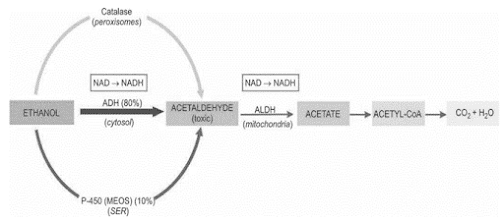
ADH = Alcohol Dehydrogenase; ALDH or ACDH = Hepatic Acetaldehyde Dehydrogenase; NAD = Nicotinamide Adenine Dinucleotide; NADH = Reduced NAD
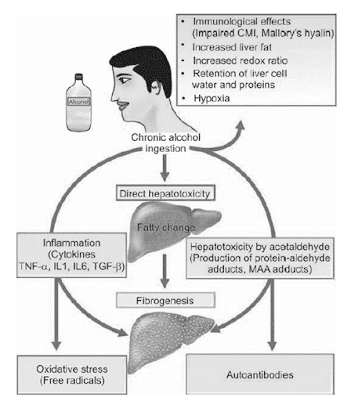
• Direct hepatotoxicity by ethanol to microtubules, mitochondria, membrane hepatocytes
• Hepatotoxicity by ethanol metabolites
– Production of protein-aldehyde adducts
– Formation of malo-di-aldehyde-acetaldehyde (MAA)
• Oxidative Stress - oxidation of ethanol by cytochrome 450 oxidase, generation of free radicals and oxidative damage
• Immunological attacks on hepatocytes
• Fibrogenesis
– Damaged hepatocytes,
– Malon-di-aldehyde-acetaldehyde adducts,
– Activated kupffer cells, and
– Direct stimulation by acetaldehyde
Laboratory Diagnosis For
• Elevated transaminases: increase in SGOT (AST) is more than that of SGPT (ALT)
• Rise in serum γ-glutamyl transpeptidase (γ-GT)
• Elevation in Serum alkaline phosphatase
• Hyperbilirubinaemia
• Hypoproteinaemia with reversal of albumin-globulin ratio
• Prolonged prothrombin time and partial thromboplastin time
• Anemia and Neutrophilic leucocytosis
Summary
• Alcohol liver disease is damage to liver and its function due to alcohol abuse
• Progresses in the liver as inflammation (hepatitis) and leads to fatty liver and cirrhosis
• Major forms include hepatic steatosis, hepatitis, cirrhosis
• Alcohol is a caloric food source which displaces nutrients
• Causes the activation of Kupffer cells and release of proinflammatory mediators

0 Comments: